
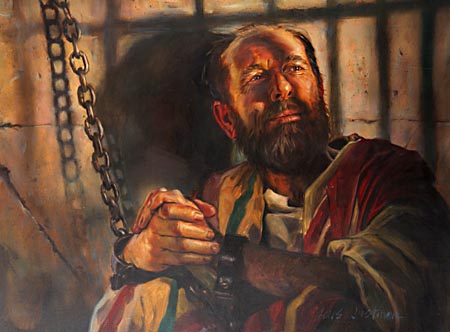
Sitting in church this morning with my first coffee of the day in hand, we kicked off a new teaching series through the letter to the Philippians called “Rejoice”. At first glance, it feels like a bit of an odd title if you know the backstory and look at where Paul actually was when he wrote it.
He wasn’t putting his feet up in a quiet study with a freshly brewed cuppa; he was locked in a Roman prison cell, uncertain of what tomorrow looked like, or even if he’d walk out alive. Yet despite the rough stone walls and the uncomfortable clink of chains, joy runs straight through the heart of his words.
I’ll admit, as a new Christian, sitting there listening to the words spoken, I realised I needed to hit pause and do some homework on Paul’s backstory to truly get it. If you only know him as the guy who wrote half the New Testament, it’s easy to picture a mild-mannered, holy figure floating about in pristine robes. Yet, the reality is far more grittier than that.
So, when I arrived home later this morning, my deep-dive research quickly began, and I learned that before he was known as Paul the apostle, he was Saul of Tarsus – a brilliant, fiercely zealous religious enforcer. His life’s mission wasn’t spreading the Gospel, but actively hunting down anyone who followed Jesus. He held the coats of the men who stoned Stephen, the first Christian martyr, and went door to door, dragging men and women off to prison without a second thought. He was the church’s public enemy number one. For the younger generation, much like what the Joker is to Batman!
Then came the turning point on the dusty road to Damascus.
Armed with arrest warrants, he was struck by a blinding light and a voice that knocked him flat on his back: “Saul, Saul, why do you persecute me?” In a split second, everything he thought he knew instantly crumbled. Struck temporarily blind and completely humbled by the moment, the man who set out to crush the faith, ended up completely conquered by grace. That single encounter redefined his entire existence. God gave him a brand-new name and an audacious purpose: to carry the name of Jesus to the Gentile world, no matter what it might cost him along the way.
And it cost him almost everything. His CV quickly filled up with beatings, riots, three shipwrecks, sleepless nights, more beatings, and thousands of miles on the road.
That journey eventually led him to Philippi, a bustling Roman military town packed with retired legionnaires. Naturally, planting a church there was anything but a quiet, polite affair. Before long, Paul and his companion Silas were stripped, flogged, and thrown into the deepest, dampest dungeon with their feet clamped in stocks. But instead of moaning about the testing conditions, the pair spent midnight singing hymns at the top of their lungs until an earthquake shook the foundations and blew the prison doors right off. That chaotic night led directly to the jailer and his entire family coming to faith, joining forces with a wealthy businesswoman named Lydia who sold purple fabrics. Together, this wonderfully eccentric, unlikely bunch became the beating heart of the Philippian church. Pretty amazing when you really take a moment to think about it, isn’t it?
Knowing that history makes this letter hit completely differently. When Paul writes back to them years later, once again under armed guard in Rome, he isn’t dispensing arm’s-length advice or neatly prepared theories. He has bled with these people. He has shared prison cells in their hometown. So when he tells them from behind iron bars, “I have you in my heart,” it isn’t cheap sentiment; it’s forged in genuine fire.
It served as a powerful reminder this morning of what Christian community actually is. We aren’t called to walk this path alone, isolated in our own heads or trying to muscle through tough seasons solo. God deliberately brings different lives, messy pasts, and varied stories together, giving us a common purpose and binding us to each other. We are far more than just a church; we are a community, a family ready to share the gospel.
During the sermon, Rev. Jeff shared a mental illustration that fit this whole picture so very well. He spoke about his younger years and how much he loved painting. He recalled working on one specific piece of art for months on end. Everyone who passed by assumed it was complete, telling him it looked brilliant and must be nearly finished. But Jeff knew better. Leaning in close to the canvas, he could see every tiny detail that still needed his attention, every brushstroke that required a little more blending, and every quiet change that had to happen before the work was truly ready.
He went on to explain that he pictures this image of the painter and his canvas as capturing how God deals with us, and how He dealt with Paul. From the outside, we might look like we have things relatively sorted, or on rougher days, we might feel painfully aware of our jagged edges and old mistakes. Yet God isn’t in a frantic rush, and He certainly hasn’t abandoned the easel. He is still actively at work within each of us and across our whole community. As Paul famously reminds the Philippians right near the start of his letter, the God who began a good work in us isn’t going to wander off and leave it half-done. He will carry it through to completion.
Walking out into the hall afterwards for a celebratory slice of cake and my third hot coffee, marking our lovely church members Jim and Andrea’s 50th wedding anniversary, (many congratulations to the two of you!), that thought brought a proper sense of peace. None of us has to be the finished article right now. We just have to stay open to the Artist’s hand, trust the work He’s doing under the surface, and find our joy in each other along the way, even if we all can be a little irritating from time to time (Jeff’s words, not mine!)
I must admit, I do love a thought-provoking Sunday service. How about you? Share your thoughts with me in the comments below.


Leave a Reply